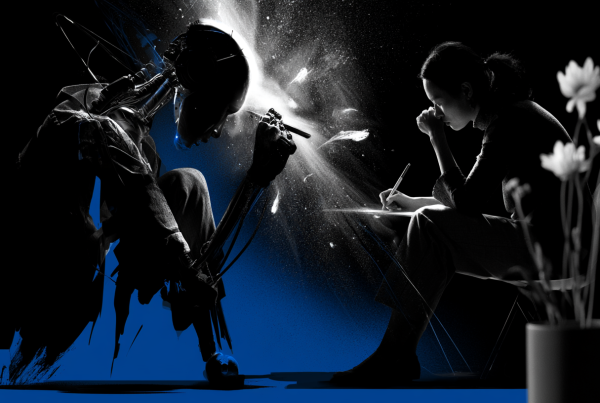
Understand why rapid technology shifts elevate—rather than replace—the critical need for human aesthetic judgment.
Automation is having its big moment in design, and fair enough. Layout engines are faster than any team I’ve ever managed. They can resize a campaign into twenty formats before a human has finished arguing about the headline. They can test variants, follow rules, keep spacing clean, and make an average asset look competent at industrial scale.
That’s the good news.
The bad news is that competence is now cheap. And when competence becomes cheap, taste becomes expensive.
This is the part a lot of teams still don’t want to admit. Automated systems don’t remove the need for art direction. They make it more important. Because once everybody has access to tools that can generate “pretty good” layouts on demand, “pretty good” stops being a competitive advantage. It becomes table stakes. Your brand doesn’t win because the margins are mathematically balanced. It wins because somebody with judgment knew what to emphasize, what to strip away, what to make loud, and what to leave quiet.
Automation can spit out layouts all day, but without a real art director making the hard taste calls, your brand is just another well-dressed algorithm.
Automation Is Great at Production, Not Point of View
I’m not anti-automation. I like anything that kills repetitive labor and frees creatives from resizing banner ads until their soul leaves their body. If a system can build versioning logic, adapt grids, swap copy blocks, or localize assets faster than a human, good. It should. No one should pretend manual repetition is some sacred artistic ritual.
But production efficiency and creative authority are not the same thing.
A layout engine can optimize for consistency. It can follow a design system. It can honor constraints. It can even simulate hierarchy based on learned patterns. What it can’t do—at least not in the way a strong creative lead can—is decide what kind of tension a brand should create. It can’t sense when something is too polished to feel credible. It can’t always tell when an image is technically perfect but emotionally dead. It can’t understand that the right answer for one campaign is a cleaner grid, while the right answer for another is to break the grid on purpose because the brand needs friction, urgency, or attitude.
That’s point of view. And point of view is where brands actually separate.
Machines are good at averaging. Great brands rarely come from averaging. They come from conviction.
Brand Systems Need Taste, Not Just Rules
A lot of marketing organizations confuse brand governance with brand clarity. They think if they build a larger toolkit, a tighter component library, and more locked templates, the work will become better by default. It usually becomes more uniform by default. That is not the same thing.
Uniformity is comforting because it looks organized in a deck. But real brand strength isn’t just whether assets match. It’s whether the brand feels like itself across contexts. And that requires taste, because context changes everything.
A homepage hero, a product launch film, a pitch deck, a paid social carousel, and an event wall should not all express the same energy in the exact same way. If your automation stack applies the same visual logic everywhere, you don’t have a strong brand system. You have a branding vending machine.
Art direction is what keeps a system alive. It decides when the rules should be followed strictly and when they should be bent to protect the bigger idea. A junior team can apply standards. An automated engine can enforce standards. But knowing when standards are making the work worse? That still takes a human with experience.
Some of the best brand decisions are technically inconsistent and strategically right. That sentence makes operations people itchy, but it’s true.
The Real Job Is Editing
If you want to understand where human value is rising, look at the act of editing.
When technology floods the room with options, the winning skill is no longer generating possibilities. It’s recognizing which possibilities deserve to survive. That’s art direction in plain English. Selection. Restraint. Sequencing. Emphasis. Killing the thing that took effort because it’s not actually helping.
Most bad creative isn’t bad because nobody worked hard. It’s bad because nobody edited hard.
Automated layout systems are option factories. They can produce endless permutations of size, crop, alignment, palette emphasis, typographic hierarchy, and image treatment. Fine. Useful, even. But if your team can’t quickly say, “This is the one that feels premium,” or “This one suddenly feels too generic,” or “This one looks expensive in the wrong way,” then speed just gives you more chances to publish mediocrity faster.
Creative teams should stop thinking their main job is making more things. Increasingly, the job is curating what matters. The machine can cover the wall with ideas. The art director still decides what belongs in the show.
Why Human Judgment Gets More Valuable as Tools Improve
This is the irony people miss. Better automation doesn’t reduce the need for judgment. It raises the stakes on judgment.
When tools are primitive, everyone expects roughness. When tools become slick, everyone can look polished. That means polish stops signaling quality. The differentiator shifts upward, from executional adequacy to aesthetic intelligence.
In practical terms, that means a brand leader now has to answer tougher questions:
Does this feel culturally aware or just trend-compliant? Does this image composition create desire or just fill space? Is the typography creating authority, warmth, irreverence, urgency—or is it simply legible? Does the work have rhythm, contrast, and a reason to exist, or is it just clean because the software made it clean?
Those are not software questions. Those are judgment questions.
And judgment is shaped by references, experience, instinct, mistakes, timing, culture, and a weird accumulation of visual memory that no brand playbook can fully capture. Good art directors don’t just know what looks good. They know why something feels wrong before the rest of the room can articulate it. That skill becomes priceless when everyone else is dazzled by output volume.
What Marketing Teams Should Actually Do
If you’re building a modern marketing creative operation, the move is not to resist automation. The move is to reorganize around it intelligently.
First, automate the obvious. Versioning, reformatting, resizing, language swaps, basic content population, and repetitive layout adaptation should absolutely be systematized. Save human time for decisions that matter.
Second, put your strongest visual thinkers earlier in the process, not later. Too many teams use art direction as final-stage polish, like someone sprinkling premium dust on pre-made work. That’s backwards. Art direction should shape the logic of the system, the image standards, the compositional tensions, the motion behavior, the cropping principles, and the moments where the brand is allowed to surprise people.
Third, define taste in usable terms. Not vague nonsense like “bold” or “modern.” Those words are basically corporate wallpaper. Build sharper criteria. What does “premium” mean for your brand—quiet confidence or exaggerated luxury? What does “playful” mean—awkward charm or bright chaos? What kind of imperfection is acceptable? What kind of symmetry kills the mood? Give your teams language for judgment, not just rules for assembly.
Fourth, review outputs like an editor, not a traffic manager. Don’t ask only whether the asset is on-brand and on-time. Ask whether it has presence. Ask whether the hierarchy creates desire. Ask whether someone made a real decision, or whether the software simply filled the frame.
Templates Don’t Build Distinctiveness
There’s a fantasy in corporate creative circles that if you just create the perfect template ecosystem, the whole company will suddenly produce better work. I’ve seen this movie. What usually happens is that a company produces more consistent mediocrity at scale and mistakes that consistency for excellence.
Templates are useful. They are not a strategy.
Distinctiveness comes from a set of choices that feel owned. Maybe it’s a certain photographic distance. Maybe it’s a brutal use of negative space. Maybe it’s a type hierarchy that refuses the obvious. Maybe it’s motion that feels intentionally restrained while every competitor is doing too much. Those decisions don’t emerge from templating alone. They come from somebody caring enough to make non-generic calls and defend them.
This is why the strongest creative organizations are not the ones with the most assets. They’re the ones with the clearest eye. They know what belongs. They know what to reject. They know that not every available capability should be used just because the platform can do it.
The Future Belongs to the Teams That Can Curate
The creative director of the next few years is not going to win by manually controlling every pixel. That model is already fading, and honestly, good riddance. The scale is too big, the channels are too many, and the speed requirements are too real.
But the opposite model—where humans just step aside and let automated systems handle visual communication—is equally foolish. Brands are not spreadsheets with better fonts. They are emotional signals. They live or die on perception. And perception is shaped by nuance, contrast, timing, and taste.
So yes, use the machines. Build the engines. Accelerate production. Remove drudgery. Systematize what should be systematized.
Then put an actual human with standards in charge.
Because in a market full of fast, competent, automated creative, the brands that stand out will be the ones that feel chosen, not merely generated.